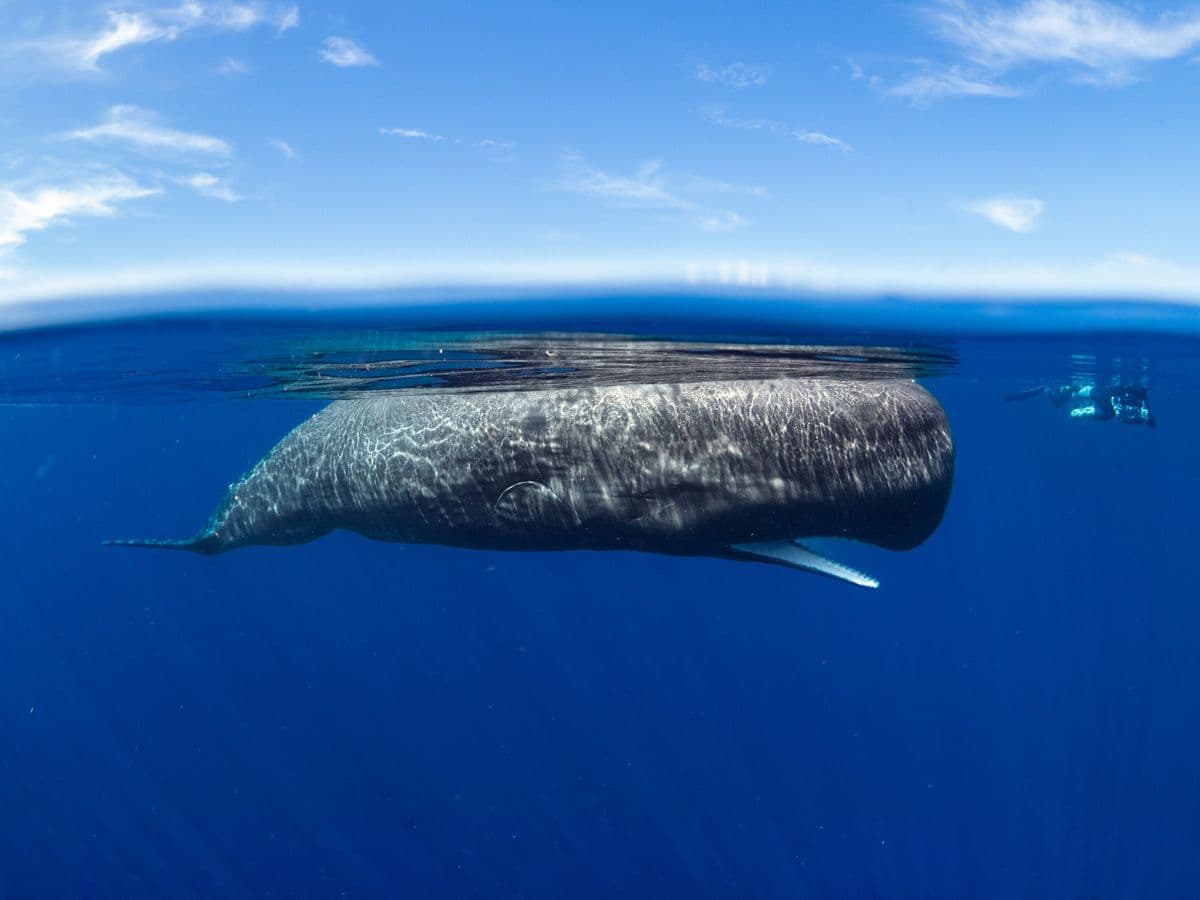
A few years ago, off the west coast of Dominica, a nine-metre female called Zami rolled slowly onto her side to look at a group of snorkellers floating an arm's length away. She examined them one by one. Then she brought her great head gently beneath one of them, lifted him clear of the water, and let him slide back down her flank like a child off a slide.
Encounters like that are why Dominica has quietly become one of the only places on earth you can get in the water with sperm whales — the largest toothed predator alive. Here's how it works, when to go, and who it's really for.
At a glance
- What · in-water encounters with wild, resident sperm whales
- Where · the sheltered Caribbean (west) coast of Dominica, eastern Caribbean
- Best months · mid-November to March for the fullest activity; May to July for the calmest, quietest water
- Trip style · land-based, staying on the island; permitted day boats out to the whales
- Fitness needed · enough to climb out of a swimming pool without the steps
- Not to be confused with · the Dominican Republic (a different country entirely)

Why does Dominica have resident sperm whales?
It comes down to geography. Dominica is built from nine volcanoes, and on its Caribbean side the seabed falls away almost immediately — you can be over a thousand metres deep less than a mile from shore, with no continental shelf to cross. That deep water sits sheltered from the Atlantic wind, so the sea stays calm.
The island also has more rivers than there are days in the year, and all that freshwater pours nutrients into the ocean just off the coast. Nutrients feed squid; squid feed sperm whales. The result is a rare thing: deep, food-rich, sheltered water within sight of land, and a population of whales that stays.
An estimated 300 sperm whales range across the eastern Caribbean, and around 70 are considered resident to Dominica — organised into close family units that researchers know as individuals, many of them named. These are matriarchal families of females and young; adult males arrive only seasonally, from around mid-December to March, to mate.
The world's first sperm whale reserve
In 2023, Dominica established the world's first marine protected area created specifically for sperm whales — roughly 800 square kilometres of their core habitat given legal protection.
For a traveller, that matters in a practical way. In-water encounters run under a permit system with a strict code of conduct: a limited number of boats, trained skippers, and government observers who ride along to keep operators honest. Beyond eight miles offshore is left as a buffer zone for the whales entirely.
This is the part of the story Atollier cares most about. The best wildlife encounters in the world are not the wildest — they are the best managed. Elsewhere that hasn't held: in Mauritius, one of the only other places with a year-round population, unregulated swimmers chasing an image have pushed the resident whales down toward a couple of dozen animals. Dominica has watched that happen and chosen the harder, better path.
What is a sperm whale encounter actually like?
You don't dive with sperm whales — you snorkel, on a single breath, at the surface. A typical day starts around 7:30am on a sport-fishing boat, listening. Every twenty minutes or so the guide drops a hydrophone and turns it, listening for the *click… click… click* of a foraging whale; the Dominica families even have their own "coda," a rhythmic signature that means, more or less, “I'm a sperm whale from here.”
When whales are found, the boat eases ahead of them and cuts the engine. Small groups slip in quietly, lie flat, and let the whales decide. The cardinal rule is that you never chase — you make yourself small and let the animal come to you. Sometimes it's a ten-second glide-by. Sometimes it's ninety minutes with a family socialising, rubbing against each other, a young whale playing with a leaf. Occasionally, in glass-flat water, a guide will catch the moment a group settles into its strange vertical sleep, hanging head-down just below the surface, and get everyone in.
Look into the eye at close range — the largest of any animal on earth — and, as more than one guest has put it, something comes back.

Dominica or the Dominican Republic?
They are two completely different countries, and it's one of the most common mix-ups in ocean travel.
Dominica (dom-in-EEK-a) is a small volcanic island between Guadeloupe and Martinique, and it's the one with resident sperm whales.
The Dominican Republic is a much larger nation sharing the island of Hispaniola, better known for humpback whales that pass through seasonally.
If you want sperm whales in the water, you want Dominica. Book those flights carefully.
When is the best time to go?
There are two good windows, and they suit different travellers.
Mid-November through March brings the fullest activity, including the chance of an enormous adult male among the females — and statistically the strongest run of in-water days. It's also the busier, more popular season.
May to July is the quiet season, and underrated: the sea goes flat, cruise ships are gone, and you can have the water to yourselves — though Saharan dust and sargassum can soften visibility for photography. Avoid late September and October, the wettest stretch and the historical peak for storms. Winter air and water both sit around a comfortable 27–28°C.
One honest note worth setting before you go: this is wild, and no week is guaranteed. A strong week might mean four of six days with an in-water encounter; a rare quiet week means you were there for the ocean on its own terms. Come for that, and you'll never be disappointed.
Who is it for (and how fit do you need to be)?
You do not need to be an athlete, and you do not need to be a diver. The honest benchmark guides use is this: can you climb out of a swimming pool without using the steps? If so, you can do this — guests have included an eighty-year-old with a triple heart bypass. There's plenty of help in the water, and because you never chase the whales, there's no long swim to keep up.
What it asks for instead is patience, and a certain kind of traveller — someone who would rather earn a real encounter than be handed a staged one. It is not a fly-and-flop beach holiday. It is a trip you take because the animal is the point.
Beyond the boat: Dominica ashore
Boats are back by early afternoon, and Dominica markets itself, rightly, as the Nature Isle. From a base in the south around Soufrière you can walk the coast to Scotts Head and snorkel its marine reserve, soak in beachside hot springs beside a rum-punch bar, hike to waterfalls, and swim up Titou Gorge (a *Pirates of the Caribbean* filming spot). The capital, Roseau, is twenty minutes away, and the island's dive community runs coral-restoration projects you can visit.
How to get to Dominica
Dominica sits in the eastern Caribbean between Guadeloupe and Martinique. From the UK, the usual routes connect through Barbados or Antigua; from North America, through Miami (up to eight flights a week in season) or Newark.
Travellers coming via France can route through Guadeloupe or Martinique and take a short local flight or ferry, and inter-Caribbean hops connect from St Lucia, Antigua and St Maarten.
Travel with depth
Swimming with sperm whales in Dominica is not an easy thing to arrange, and it isn't meant to be — the permits, the seasons, the reading of the water are exactly what keep it worth doing. It's the kind of experience that isn't found through a search box.
If today's story has you thinking about being in that water, [start a conversation](#) with Atollier and we'll help you plan it properly — the right season, the right operator, the right week.
This article draws on a podcast episode by Atollier with Christopher Bartlett, who has led more than thirty expeditions to Dominica.