At the lodge on Alphonse Island there is a swimming pool, and for most of the day it sits empty.
That isn't a criticism - it's the whole point. On Alphonse, a coral atoll some 400 kilometres beyond the last of the Seychelles' granite islands, the pool is empty because the guests are somewhere better: drifting over a manta ray, wading through a lagoon full of young sharks, or lying flat in open ocean as sailfish streak past. "Barefoot luxury" is one of the most worn-out phrases in travel. Alphonse is one of the few places that actually means it.
At a glance
- Where · the outer islands of the Seychelles, ~400km southwest of Mahé
- The lodge · Blue Safari's 37-room, owner-run resort on Alphonse Island
- Best months · October–April for the marine season; May–September for whales and birds
- Who is it for · travellers who count wild, remote nature as the luxury — not fly-and-flop
- Getting there · fly to Mahé, then a chartered flight of about an hour over open ocean

What does "barefoot luxury" actually mean?
Ask Elle Brighton - a marine biologist who has lived and worked on Alphonse for more than six years - and the definition has nothing to do with thread counts.
Luxury here is access, not ornament. It's the ability to reach one of the wilder, more remote corners of the ocean and experience it in comfort - then come back to a table where the fish was caught that morning and the vegetables were grown a short walk up the beach. Shoes are optional. An endemic lime-green gecko may join you at dinner. You might get caught out by a passing seabird. None of that is a flaw in the experience; it is the experience.
Where is Alphonse Atoll?
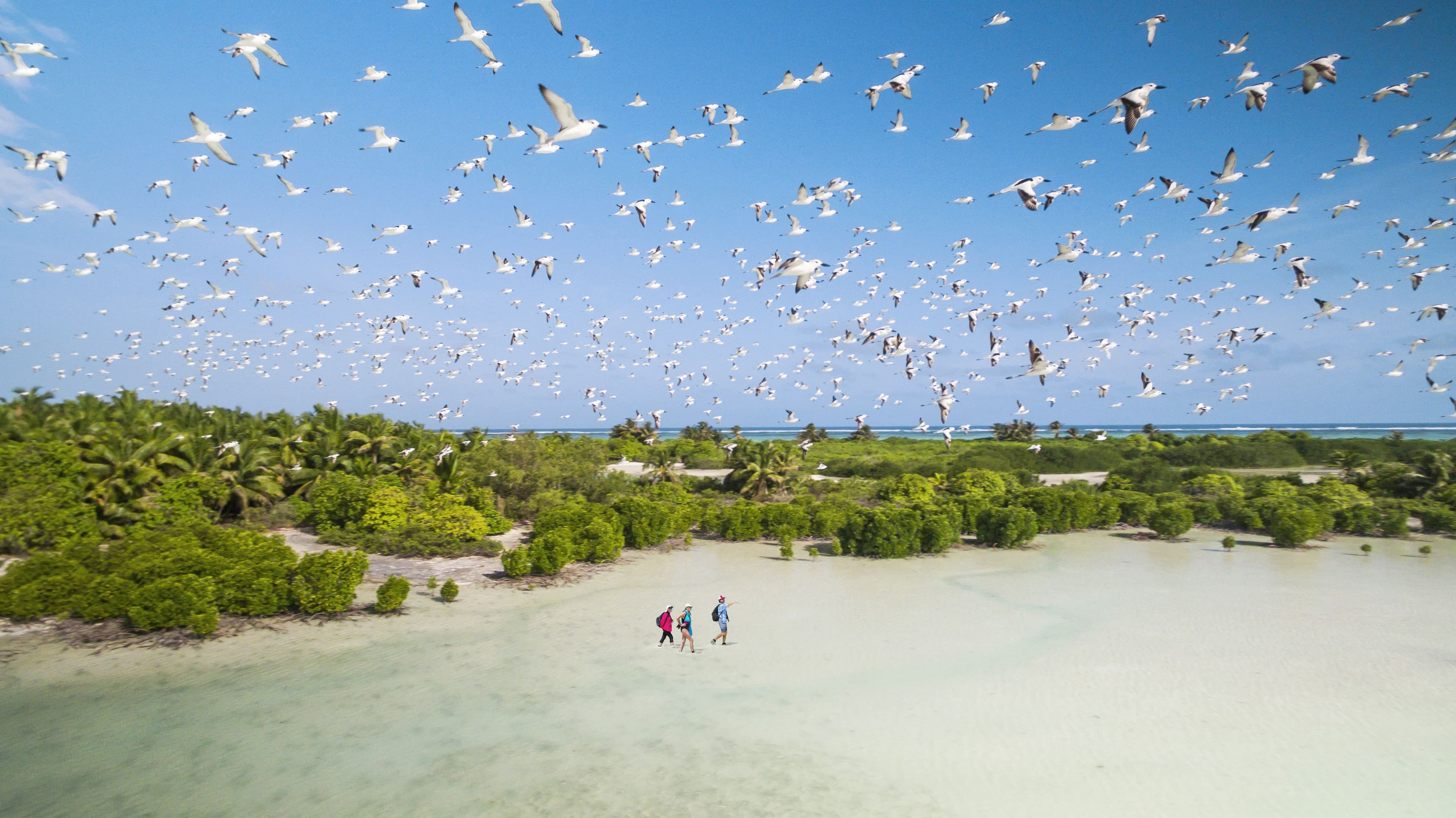
Alphonse sits in the outer islands of the Seychelles, about 400 kilometres southwest of the main island of Mahé, out where the archipelago turns from granite to coral. It is properly remote: stand on three of the island's four coastlines and there is open ocean to the horizon and nothing else. The nearest neighbouring island is more than 70 kilometres away, and uninhabited.
That distance is why the sea around it is so alive. Elle describes putting her head underwater on Alphonse for the first time and thinking, this is what a coral reef is supposed to look like — the fish in the right numbers and the right sizes, species grown larger than she'd seen anywhere people fish. The Alphonse group is really two atolls, Alphonse and St François, the twin peaks of a single undersea mountain. The lodge sits on Alphonse; the rest is given over to nature.
Why the pool sits empty: nature is the product
Blue Safari builds its days around getting you into the water, not lounging beside it - and the signature experiences double, quietly, as conservation projects:
- Manta rays: swim with them while helping photograph the ID markings on their bellies for the Seychelles Manta Ray Project; the St François lagoon may even be a manta nursery, which would make it one of only a handful known anywhere.
- Turtles: green and hawksbill turtles nest here in their thousands, monitored since 2007; the hawksbills nest by day, something seen almost nowhere else on earth but the Seychelles and Chagos.
- The St François lagoon walk: wade crystal shallows past baby lemon sharks, stingrays and mangroves in a lagoon designated an Important Shark and Ray Area in 2024.
- Saltwater fly fishing: the outer islands are a byword for it: strictly catch-and-release, under a code of conduct tied to live research with University of Massachusetts scientists.
- Sailfish snorkelling: lured in with no hooks, then you slip into open ocean among them; something almost no other resort in the world offers.
Come for a few days of doing nothing and you'll still be immersed in it - turtles surface off your veranda, and over 1,500 frigate birds roost on the island year-round, wheeling overhead as you lie on the beach.


Owner-run, and you can feel it
Alphonse isn't a corporate chain with a nature package bolted on. It's owner-operated - the CEO is a part-owner and founder, and the people making the decisions know the atoll intimately and care about it deeply. That runs through everything: a 4.8-hectare farm grows over 80% of the produce, the fish is caught sustainably one at a time, and dinner is genuinely farm-and-sea to fork, from within a kilometre or two of your plate.
You feel it in the register, too. Shoes-off, staff and guests chatting at the bar, a family feeling that shows up in the numbers - more than three-quarters of guests come back. That warmth is the part no brochure can photograph, and it's a large part of what makes the place what it is.
Who Alphonse is for (and who it isn't)
The guests who get the most from Alphonse understand that luxury is the wildness itself. You do not need to be an athlete - you can drift along a current over pristine reef, or simply watch it all from the beach - but you do need to want to be in it. This is not a place to sit by a pool and look at your phone; the atoll has too much to offer for that.
It suits travellers happy with a little seagrass on the beach, geckos in the room and the odd seabird overhead - the small, real signs that you are somewhere genuinely wild. Most guests leave calling it one of the most remarkable places they've ever been.
When should you go?
Alphonse runs on two seasons, and each offers something different.
The marine season (October–April) is when the water calms and the diving and snorkelling come into their own: pelagic life and sailfish from October to December, manta courtship around December–January, and the glassy, flat, warm water of February–March with visibility that can top 40 metres. (November is Elle's own favourite.)
The island season (May–September) brings the southeast trade winds and a quieter, more restful mood - huge numbers of frigate birds, and the humpback whales that migrate through to calve, with a bumper year roughly every three or four.
How to get to Alphonse
Reach Mahé first - connections run via the Middle East (Dubai, Doha), via Addis Ababa on Ethiopian Airlines, or on direct services from Paris, Zurich, Frankfurt and Rome; travellers from Asia can route via Mumbai or Colombo. From Mahé, a chartered flight from the domestic terminal makes the final hop - about an hour over 400 kilometres of open ocean to the atoll.
Travel with depth
Alphonse is not an easy place to get to, and that is inseparable from why it's worth it. It's barefoot luxury in the original sense - the wild, and the ocean, met in comfort rather than swapped for it. The kind of place not found through a search box.
If it sounds like your kind of water, start a conversation with Atollier and we'll help you plan it - the right season, the right rooms, the right week.
This article draws on a podcast episode by Atollier with Elle Brighton, marine biologist and conservation manager on Alphonse.